
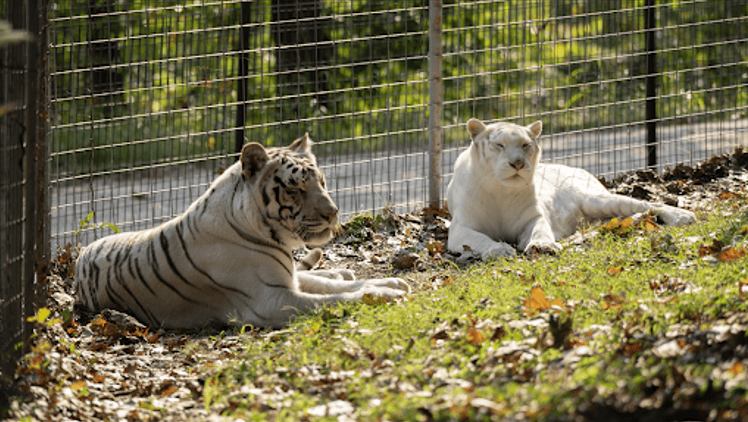
For many of us, the winter is the time when we feel the need to slow down and cozy in. For tigers in the wild, the winter marks the beginning of something new. The majority of tiger cubs are conceived between November and April. The next generation of wild tigers is almost entirely dependent on this time of year and the mating practices of their parents. We, as advocates and scholars, find it important to educate ourselves about these rituals so that we may better understand these majestic cats and the survival of their species.
Induced Ovulation
Tiger mating can occur at any point throughout the year. Mating occurs through the winter and spring most commonly, but tigers do not technically have a “mating season” like some other animals. This is because cats are induced ovulators. Female tigers reach sexual maturity between 3-4 years of age, and from then on she will go into estrus every 3-9 weeks. During this cycle, the tigress will be receptive to breeding. However, she will not ovulate or be able to conceive until after breeding occurs.
The Dance
Biologically speaking, conceiving a litter of cubs is already a bit complicated for tigers. Socially, there is an entirely different layer of hoops to jump through. Tigers are not known to be social creatures, and periods of breeding are one of the only exceptions to their solitary lifestyle. A male’s home range can be triple the size of a female’s. This allows him to have multiple potential mates in his territory at once. When one of the females in his range goes into estrus, he will follow scent markers and vocalizations to find her.

The first meeting is usually awkward and often aggressive. The pair may approach one another, mock aggression, retreat, then come back to one another several times. This is when the female’s readiness, and the male’s dominance is established. Upon calming down, they begin to circle one another, nuzzle each other’s faces, and vocalize to each other.
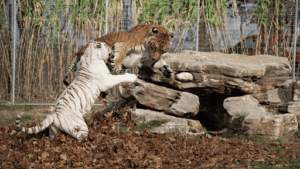
When she is ready, the female will make a grand gesture to the male by crouching on the ground. The male positions himself behind her and lightly bites the female on the back of the neck. This stabilizes the tigress during this natural, but painful, process. After 15-30 seconds, the male recedes and the act is done.
Courtship
However, this is not the end of their courtship. Because tigers are induced ovulators, mating must occur multiple times within 24 hours to ensure conception. Breeding pairs have been reported to mate upward of 50 times in a day. This means they must stay close to one another. Both males and females will mate with multiple partners throughout their lifetime, but during a courtship period, they become entirely monogamous, and they form an incredible bond. For 3-5 days, the two tigers spend every moment together. They will hunt, eat, swim, and sleep in each other’s company.
A Dynasty is Born
When the courtship phase is over, the pair part ways, and the now-pregnant female raises their young for the next 18-24 months on her own. In this time, the family may reunite for a passing moment. In these rare instances, the tigers typically have friendly interactions as the male will recognize his former mate and his young. These familial bonds are important for the species conservation and survival.
Captive Breeding
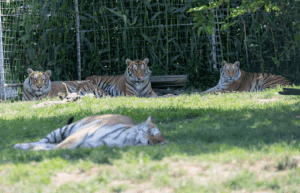
In captivity, certain AZA breeding programs are needed to conserve critically endangered subspecies such as the Sumatran tiger. Outside of these highly regulated programs, breeding in captivity should be discouraged. Historically, in captive situations, breeding pairs and their resulting cubs have been heinously exploited. Without oversight, tigers are often intentionally inbred to create rare colorations or bred to other cat species to create hybrids. This frequently leads to birth defects and lasting health issues for these animals. At TCWR, we are a non-breeding facility, but you can observe and learn about many tiger family groups that live here after being rescued from these kinds of exploitation.
Sources
https://www.youtube.com/watch?v=uGR9s_9q3Jo
https://bigcatfacts.net/tiger-reproduction-mating-and-birth/#google_vignette
https://www.bandhavgarh.net/the-social-life-of-tigers-social-behavior/
https://www.tigersafariindia.co.uk/bengal-tiger-mating-and-rearing-of-cubs/
*Published by Mack Polk on 12/09/2025*