Common knowledge can be misleading. Some common facts are known as “old wives’ tales;” others are widely believed to be the truth. And yet, no matter how widely known and spread, this information can turn out to be entirely false. In our first installment of the Animal Myths series, we will be talking about some of these common misconceptions about the most numerous type of animal found here at Turpentine Creek: cats.
Cats and Swimming
Cats hate water. It is seen time and time again by anybody who has ever tried to bathe their housecat and likely received nothing but scratches for their trouble. But this “universal truth” is not so universal as people might believe.
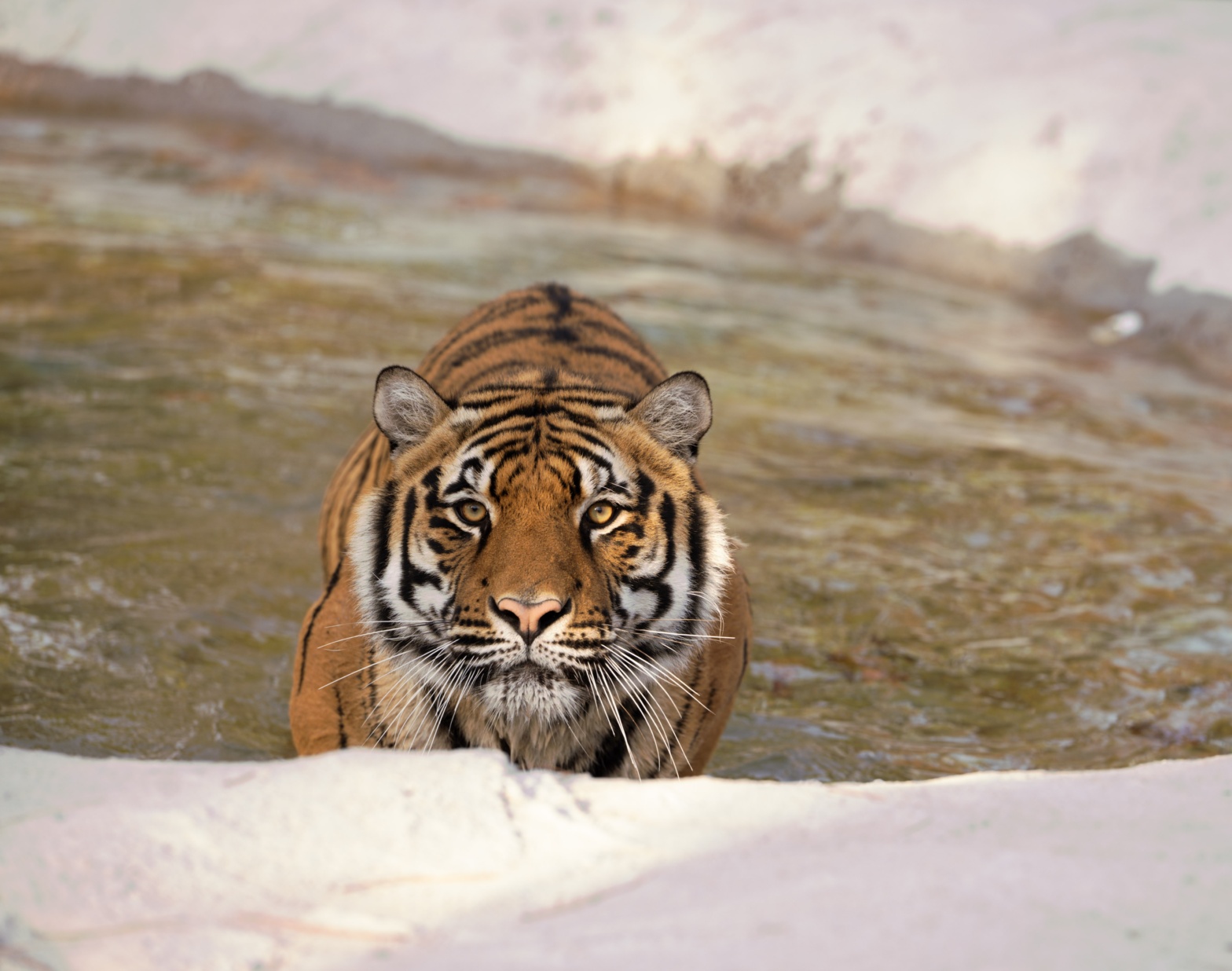
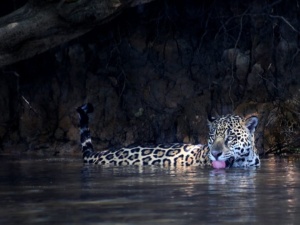
There are several species of cat that enjoy swimming, and are even very good at it. Tigers and jaguars are the two big cats most well-known for their ability to swim and even hunt in the water. Jaguars in particular will use the water to cool off, catch prey, or even escape threats. They even have the remarkable ability to hold their breaths in order to catch turtles or fish.
A smaller water-loving cat is the fishing cat. True to its name, the fishing cat primarily hunts in and around the water. Its webbed front paws and strong tail, which it uses as a rudder, are both advantageous for its watery habitat. Fishing cats will “fish” by scooping prey out of the water with their paws, and have partially protruding claws to aid in doing so.
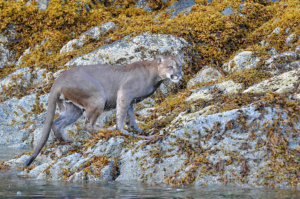
Cougars are much less known for their swimming prowess, but they will swim when necessary. This is especially notable in Washington state’s Puget Sound. In 2020, a young male known as M161 was outfitted with a GPS tracker, and later found to have swum 1.1 kilometers – over half a mile – across Puget Sound to Squaxin Island. Using that distance, scientists identified between 3,800 and 4,583 islands that cougars could potentially swim to. Scientists have confirmed their presence on eighteen of these islands. This is significant evidence: Cougars in the Puget Sound region are isolated from the rest of the Washington population by Interstate 5.
Even some housecats enjoy water. Water-loving breeds include the Maine Coon, Norwegian Forest Cat, and Turkish Van. The Turkish Van is even known as the “swimming cat” because of its propensity for swimming.
Big Cats and “Black Panthers”
When people hear the phrase “big cat,” the first animal that comes to mind is likely going to be a lion or tiger. The next is often a leopard, cougar or cheetah. This term is misleading: Just because a cat is large in size doesn’t always mean it is a big cat.
Big cats belong to the genus Panthera, in the subfamily Pantherinae. This genus consists of five different species: tigers, lions, jaguars, leopards and snow leopards. Small cats belong to the subfamily Felinae. Although usually small in size, they include larger species such as the aforementioned cougar and cheetah. A good rule of thumb to know is that, for the most part, big cats can roar but not purr, while small cats can purr but not roar.
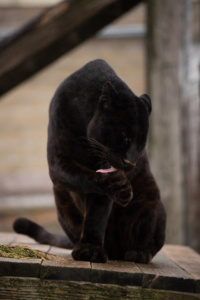
The term “black panther” is another misnomer. When people talk about black panthers, they are talking about black, or melanistic, jaguars or leopards. Panther is also another name for cougars, which are not big cats. There has never been a documented case of a melanistic cougar.
Are Cats Really Nocturnal?
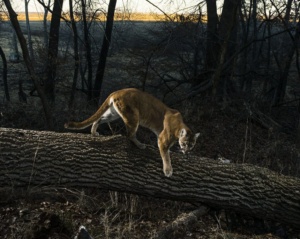
Another misconception about cats is that they are nocturnal. They tend to be more active at night than during the day, yes, but they are actually crepuscular: most active around dawn and dusk. They spend a large portion of the day sleeping to conserve energy, because their hunts are not always successful.
We are told bits of information and factoids throughout our lives. While many of these facts are true, others become passed from person to person, despite being less-than-correct. I hope that this was able to correct a few of those facts for you.
Sources
https://panthera.org/blog-post/world-wild-moments – Figure 1
https://www.eopugetsound.org/magazine/swimming-cougars – Figure 2
https://magazine.outdoornebraska.gov/stories/wildlife/the-unseen/ – Figure 3
https://felidaefund.org/learn/cats/tiger
https://www.lionstigersandbears.org/why-jaguars-love-water-a-deep-dive-into-these-incredible-big-cats/
https://felidaefund.org/learn/cats/fishing-cat
https://sdzwildlifeexplorers.org/animals/fishing-cat
https://www.eopugetsound.org/magazine/swimming-cougars
https://wildlife.org/pacific-northwest-cougars-can-island-hop/
https://www.purina.co.nz/articles/cats/behaviour/common-questions/why-hate-water
https://cfa.org/norwegian-forest-cat-article/
https://www.lifetimepetcover.co.uk/pet-advice/cat-breeds/turkish-van-breed-profile/
https://carnegiemnh.org/big-cats-big-personalities/
*Published by Eryn Meeker on 12/20/2025*