

Common knowledge can be misleading. Some common facts are known as “old wives’ tales;” others are widely believed to be the truth. And yet, no matter how widely known and spread, this information can turn out to be entirely false. In our second installment of the Animal Myths series, we will be talking about some of these common misconceptions about another animal found here at Turpentine Creek: bears.
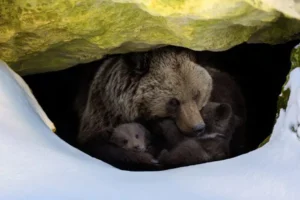
Do Bears Hibernate?
The act of hibernating means going into a deep sleep to preserve energy. An animal’s metabolic rate slows way down, which means they use less energy than they would otherwise. But what many don’t know is that there are different ways of hibernating.
Torpor is a partial hibernation in which the metabolic rate doesn’t slow as much as full hibernation. Bears go into torpor instead of true hibernation so that they are able to more easily defend their den if needed. They must wake quickly. Their metabolic rate only drops down to the point where they still conserve energy, but are still able to defend themselves. Waking from true hibernation also uses more energy than waking from torpor – not very efficient for an animal that may need to wake multiple times throughout the winter.
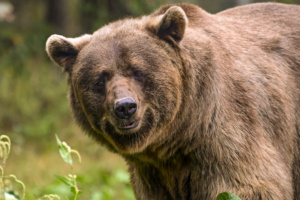
Bad Eyesight?
Bears rely heavily on their sense of smell – and for good reason. They have an incredibly good smell, over 2,000 times that of a human! This reliance on their nose has led many to believe that bears can’t see very well. A bear’s eyesight is actually comparable in quality to a human’s. They can see in color, have sharp close-up vision, and even have excellent night vision due to the presence of a tapetum lucidum, which reflects light the same way a cat’s does.
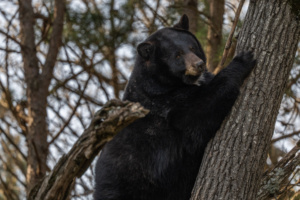
Bears Can Run Downhill
If you ever come across a bear in the wild, one thing to keep in mind is this: Don’t think you can outrun or outclimb it. Bears are excellent at both. Grizzlies, while not well-known for climbing like black bears are, can definitely still climb. And bears can run 35 mph, both up- and downhill. The fastest human speed ever recorded was 28 mph.
You cannot outrun a bear.
This was our second installment of the Animal Myths series. I hope I was able to dispel some misinformation about bears. In our third and final installment, we will be talking about an unusual animal we have here at TCWR. See you then!
Sources
Figure 1: https://www.lionstigersandbears.org/bear-hibernation-the-science-behind-their-long-winter-sleep/
https://www.fourpawsusa.org/campaigns-topics/topics/help-for-bears/brown-bear-torpor-or-hibernation
https://www.natureupnorth.org/justmynature/lizanderson/time-torpor
https://www.adfg.alaska.gov/index.cfm?adfg=wildlifenews.view_article&articles_id=135
https://www.lionstigersandbears.org/bears-and-their-keen-sense-of-smell/
https://bear.org/bear-facts/senses-and-abilities/
https://igbconline.org/be-bear-aware/encounter/#1635195741613-04049327-a828
https://blog.nwf.org/2013/12/5-myths-about-bears/
https://www.universityofcalifornia.edu/news/calculating-how-fast-usain-bolt-can-run
*Published by Eryn Meeker on 02/07/2026*